Mekong Delta – where the land and waters provide


Rowing

When I was a child, we learnt a song in school that went: “planting rice is never fun, bent from morn till set of sun …” I remember singing this on road trips in Malaysia as we passed by field after field of rice paddies and the occasional water buffalo. Today though, these views have been replaced by oil palm plantations, their endless rows of palms marching inexorably into the distance. Those childhood drives through rice paddies came to mind in the Mekong Delta as we passed by jade-green rice fields. The cultivation of rice is just one of the agricultural riches that we owe to the great Mekong, Southeast Asia’s longest river.

The Mekong, Southeast Asia’s longest river, runs for 2700 miles through China, Myanmar, Laos, Thailand, and Vietnam, emptying into the South China Sea in the delta. It’s the lifeline of millions of people in the region and beyond, and you truly get a glimpse into the bounty and might of this river on a visit to the Mekong Delta in South Vietnam. Here, the river finally reaches the sea through the delta lands, crisscrossed by numerous channels and tributaries – a rich agricultural landscape where gave me a deep appreciation of the source of the food we eat every day. In addition to the paddy fields, there are lush fruit orchards (oranges, dragon fruit, durian, mangosteen, coconut and more). The area is also famous for the floating markets.

We had a motorcycle tour through the villages. As we wound our way through the paths, we heard loud sounds of chirping swallows – but they weren’t coming from real birds. The cultivation of bird’s nest has become quite the rage here because of the profits to be made, and farmers have built tall barns for swifts to nest in. To attract the swallows, the farmers broadcast the calls of the swifts on outdoor sound systems.

IMG_8572

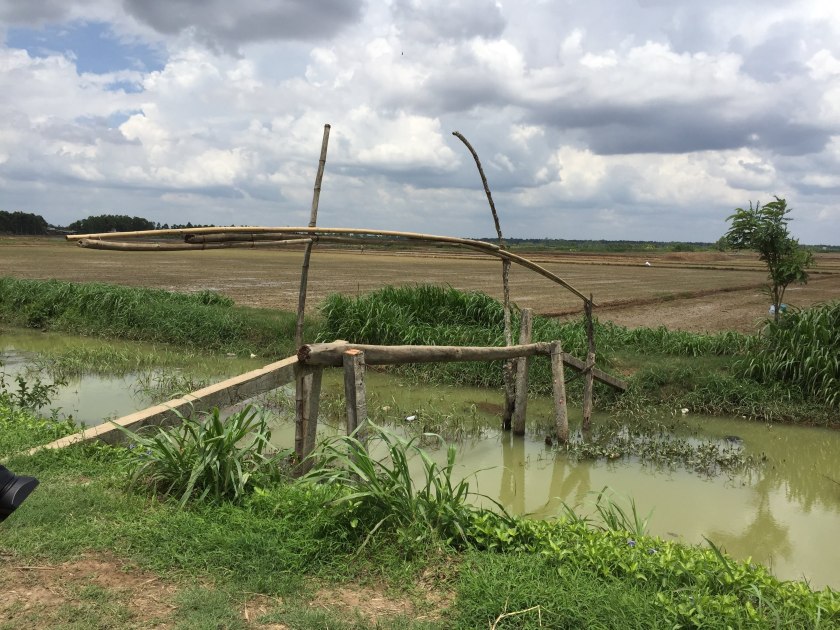
We saw rice fields up close, the bikes carefully navigating narrow paths between the paddies, the sun beating down on our shoulders. In the midday heat, dragonflies floated overhead. We passed by monkey bridges spanning ditches among the cultivated fields – I have no doubt that crossing these simple wooden structures truly requires the agility of a monkey. Needless to say, we just stopped for a photo-op and didn’t even attempt a crossing.
IMG_8584
A monkey bridge

Riding down a path, we came across an old woman counting a batch of coconuts, squatting on the ground among the coconut trees, tossing the fruits one by one from one pile to another. Suddenly we heard a mobile phone ringing whereupon she casually pulled out a mobile phone from her pocket and answered it. After a brief conversation, she squatted down and resumed her count as if the interruption never happened!

IMG_8576
Answering a phone call in the middle of counting the coconut harvest

We met some local women planting rice, bare legs half-submerged in the water. Gamely posing for photographs and laughing, they bantered good-naturedly with our young tour guide, asking if he was looking for a wife and proposing their sisters, daughters or even themselves as prospective brides. These are the indomitable daughters of the delta. Planting rice may not be fun in the heat and humidity of south Vietnam, but they still took time out to greet us strangers merrily. Or maybe, our appearance gave them with a welcome break from their labours. I wondered if their daughters and grand-daughters would continue with this back-breaking work, or if these women would prefer their children to take on less laborious jobs. In the future, who would cultivate rice – our staple food?

IMG_8605
The chatty ladies working in the rice paddies

Lunch was a home-cooked meal in a Vietnamese home, with spring rolls, pork, vegetables and a sour fish soup, complete with very large chunks of fish. Vietnamese houses always have a front porch, which is very useful in the hot summer as the family can gather there to catch the breeze. The front yards are always swept clean while the front room in the house also occasionally doubles up for motorcycle parking!

The two main towns in the delta region are My Tho, which hosts thousands of tourists embarking on cruises on this part of the Upper Mekong, with the boats passing the cultivated islands named after Vietnamese mythical animals: dragon, unicorn, phoenix and turtle. We transferred to a smaller boat at Ben Tre, where we chugged through a tranquil, narrow channel of the river, lined with trees – these channels are described as “Amazon-like” in tourist brochures. The final stop was a coconut plantation where we learnt about coconut rats – large rodents which climb up the trees to get to the juicy fruit, which the farmers keep away by nailing metal plates on the coconut trunks, as the rats will not be able to climb up the metal plates. I remembered once again the usefulness of the coconut tree: fruit for eating or to be made into sweets, juice for drinking, the shell for carving into objects, and the leaves for the roof of your house. And yes, there are plenty of opportunities to buy some coconut souvenirs here.

woman bike
Bicycle, mobile phone, and coconut trees.

It was a long day, and we headed to the biggest town in the delta, Can Tho, for the night, passing through the spectacular, Mekong-spanning 8331m-long Rach Mieu suspension bridge which was completed in 2008.
IMG_8672

IMG_8813

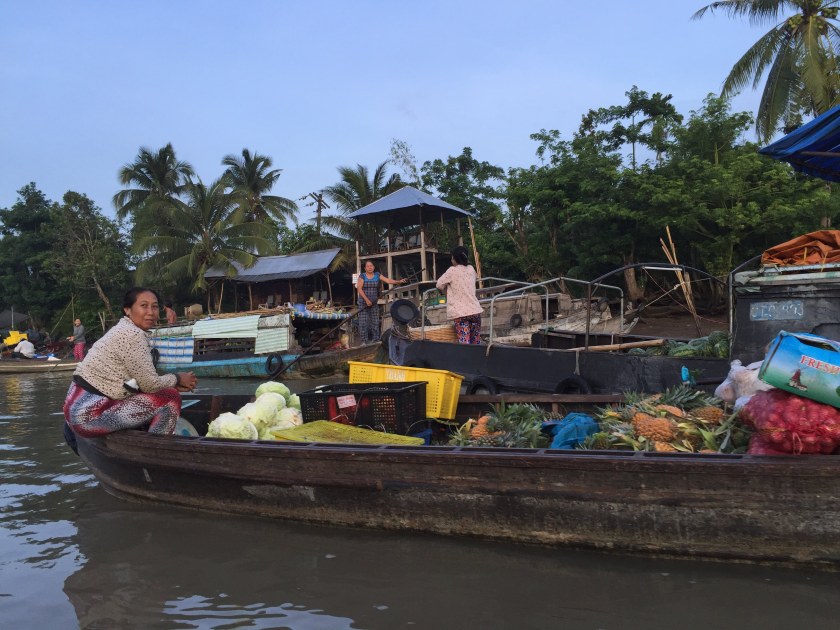
To see the floating markets, it’s necessary to stay overnight in the region – we were already on an arrow-boat and heading out to the markets at 6 am. Unfortunately it was a festival day so the markets weren’t as bustling as they normally were. These markets capture the agricultural richness of the region. Each boat had a long pole at its bow, with specific vegetables tied to the pole indicating the produce it was carrying. Transferring larger vegetables like cabbages to the buyer’s boat is simple: the crew form a line and toss the cabbages from one person to the next until it reaches the boat. Small boats selling coffee and breakfast plied between the larger boats and tourist boats.

The traders of the floating market spend weeks at a time on the river – a way of life that has its own rhythms according to the seasons. From here, the fruits and vegetables make their way to markets around the country, ferried to their destinations by truck, motorbike and even bicycle. Boats from here sail all the way to Ho Chi Minh City. This is a way of life that has gone on for generations, and is likely to continue for a while longer. And along the river, people still live in wooden houses, and use the river water for washing or for their plants. The Mekong is life. 

IMG_8730
Children outside a house in a village near one of the floating markets

IMG_8758

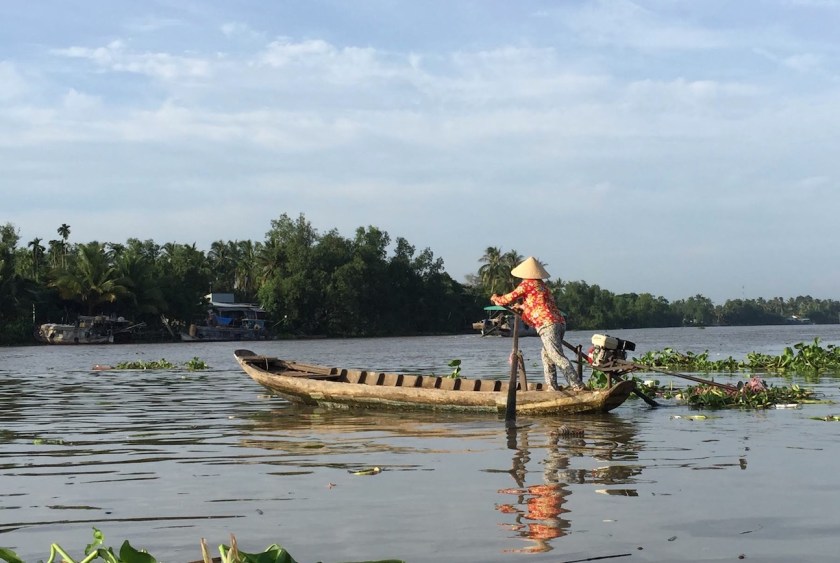
Leaving the market, our boat turned into a network of smaller tributaries and we passed quietly through a lush green landscape, passing the occasional village. It was 7 am, still early, but already time for the morning news and daily propaganda radio broadcasts amplified in the villages through outdoor speakers. Accompanied by this morning soundtrack, people went about their daily business, riding motorbikes and bicycles on narrow roads and paths and across bridges in this peaceful watery land. Women still transported goods the traditional way, on baskets suspended on either end of a wooden pole balanced across their shoulders, wearing the traditional conical bamboo hats to protect them from the sun. From the narrow tributaries, we suddenly emerged into a wider channel and came across fishermen (and women) in small boats. Time to capture some signature shots of life on the Mekong.

I imagined the Mekong as a network of veins, arteries and capillaries, bringing teeming life onto the earth and sustaining the lives of people, plants, and the very land here. Nature provides and human ingenuity over the generations has harnessed the power of the river for life and civilisation.

We also learnt that sadly, the Mekong is changing, and possibly not for the better. Further upstream, stretches of the river have been dammed for hydroelectricity, with effects on the river’s route downstream, its biodiversity, and ultimately the lives of people living along the mighty river. It’s not certain what the future will bring, and what damage we’re doing to these rich lands. 

IMG_8657


Ho Chi Minh City for the first time

Thanks to budget airlines, Ho Chi Minh City is now a regular weekend getaway for Singaporean working adults and ‘aunties’* alike. When even my mother’s friends go regularly, I knew I was already late to the table when I finally visited in 2013 with my friend S. We wanted to have a taste of today’s Vietnam (literally and figuratively – S researched what to eat and where to eat it) and could only afford a few days away, so chose to visit just one destination. We came back gushing to family and friends about our weekend, which turned out to be quite relaxing, despite the frightening traffic in the city.

The first thing we noticed was naturally, the motorcycles! The battalions of motorbikes at every traffic light were quite intimidating. On the way to the hotel from the airport, we were caught in heavy traffic. As we inched our way across a traffic intersection, the lights changed and the phalanx of motorcycles that had stopped at the lights, started moving – and looked like they would head directly INTO our car in a couple of seconds. Looking out of the window, I looked straight into a motorcyclist’s eyes … Miraculously, all the vehicles negotiated safely around our car. That, I supposed, was par for the course here.

Our first time crossing the street was just as intimidating. Even though you know the trick is to find a gap in traffic and walk confidently and quickly across – take the plunge and don’t turn back! – it wasn’t easy the first time. Eventually, we got better at it. One night, we walked quite a distance looking for a particular eating place, eventually losing our fear of crossing the streets.

I had read in a guide book that if there are policemen on the side of the street, you could ask them to help you cross, which we did a couple of times. They turned out to be quite chatty, acting more like tourism ambassadors than cops.

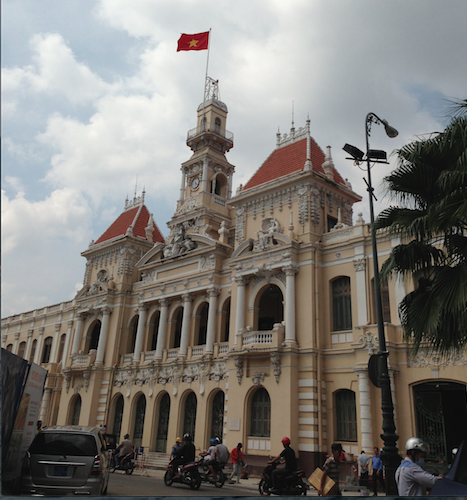
The ornate People’s Committee Building

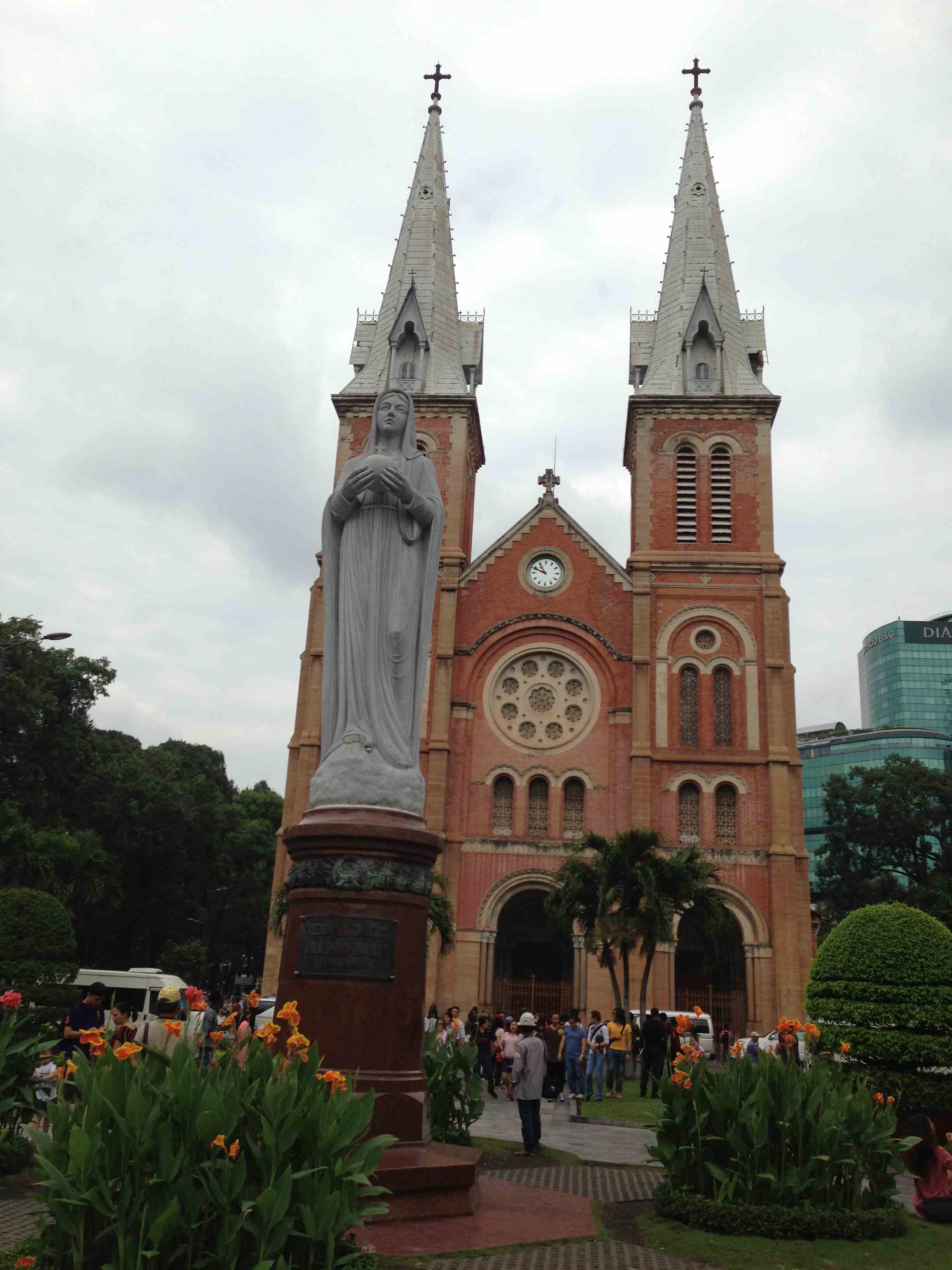
We stayed at the Saigon River Hotel, a small hotel in District 1, the city centre. It’s near Dong Khoi Street, the hub of the centre, where there remain examples of French colonial architecture. The first thing we did was walk around the area, visiting the Opera House (we tried to get tickets for the ballet, but it was sold out) and passing by other large buildings such as the impressive People’s Committee Building, formerly the Hotel de Ville. It’s not far from the Notre Dame cathedral, an unmistakable landmark in the area and a popular spot for wedding couples to take photographs. In front of the cathedral is a little park with a statue of the Virgin Mary – a souvenir photograph spot. We attended mass at the cathedral before we left the city, where I bumped into a former student as we lined up for communion – yet another Singaporean here for the weekend.

Notre Dame cathedral

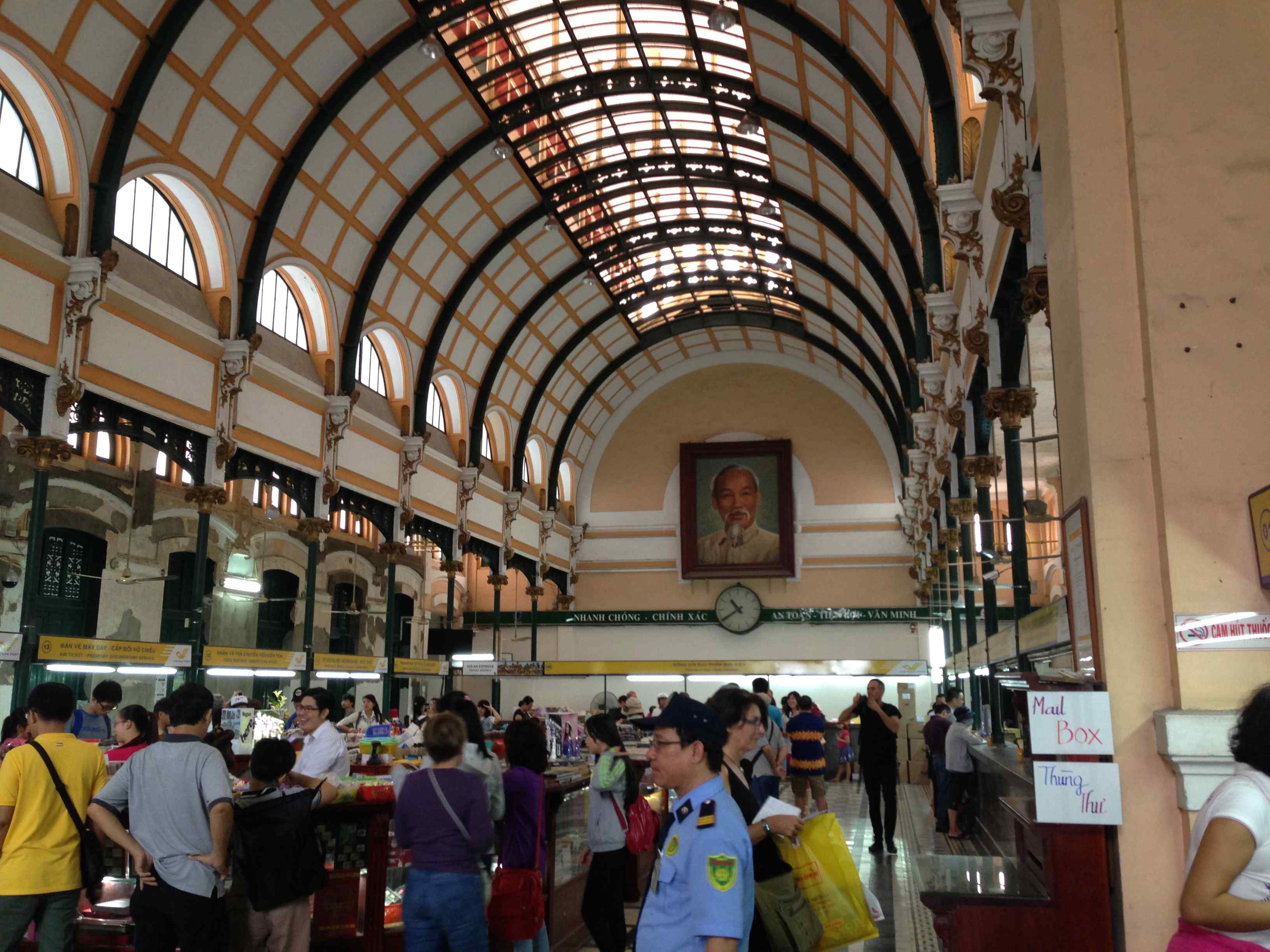
Next to the cathedral is the French colonial-era Central Post Office, dating from 1886 – 1891, and designed by Gustave Eiffel, the same man behind the Eiffel Tower. It’s a gorgeous building that looks like a Victorian-era railway station. Inside, high arched ceilings create a wonderful sense of space. On the walls are two large handpainted maps of the city and its surroundings in the 1890s. The post office counters are still fully operational  and there are quaint old-fashioned telephone booths too (which now contain ATMs). A large portrait of Ho Chi Minh looms over the proceedings.

Ho Chi Minh himself watches over the comings and goings at the General Post Office
Ho Chi Minh himself looms over proceedings at the General Post Office

Another famous tourist site is within walking distance – the Reunification Palace. You can’t miss it, with its large grounds and front lawn with a fountain. It was formerly the residence of the French Governors General, and also the home and office of the president of South Vietnam during the Vietnam war. The structure was rebuilt in the 1960s after it was bombed in 1962 by two South Vietnamese pilots, and visitors will have a glimpse of the past when visiting the Palace today. It looks frozen in time: the huge reception rooms for important guests, furnished in a pompous (almost kitschy) style, and the presidential quarters which look like they had been recently vacated by someone trapped in the 1960s. Some travel sites have compared this place to a set from a James Bond film, which I agree with, but I find this also a tad disturbing, considering the violent history associated with the palace. We stepped out onto the balcony overlooking the front lawn and took some photos, watching the endless traffic flowing past beyond the fences.

Reunification Palace - the front lawn
Reunification Palace – the front lawn

In the grounds of the palace are two potent reminders of the Vietnam War or American War: an F5E fighter plane that took part in a raid on the palace in 1975, and the tank which smashed through the iron gates on 30 April 1975 – the moment when the South fell.

The other important site of war memories is the War Remnants Museum.

Yes, we all want to have our photos taken in front of a war museum. Preferably smiling, and with a fighter plane or other weapon of war.

In the grounds are displayed vehicles of war – fighter planes, helicopters and boats, with snap-happy tourists posing beside them. Once inside the museum, the mood quickly turns somber. On the ground floor is an exhibit of photos and posters showing support from around the world for the Vietnamese in their fight against the Americans. Upstairs, there are harrowing photographs of the war and its victims, including those who are still living with the effects of Agent Orange. The captions in the exhibits are written from an entirely Vietnamese point of view, with a propagandistic, nationalistic and distinctly anti-American tone which barely hides the bitterness. Having known the War mainly through American movies and media, I have to admit this was a huge jolt to the system, but it was very educational as it gave an insight into the scars left by the conflict on this country. The final exhibit we saw however, brought a strange balance back: a poignant exhibition of war photographs taken by American photographers who were killed ‘in action’.

We definitely needed some calming moments after the Museum, and headed to a nearby café. There are cafes dotted everywhere in the city and it’s quite pleasurable lounging in a sofa (if there’s one), having some strong Vietnamese coffee, watching people, cars and bikes go by. More about coffee later …

Whiling away the time with strong Vietnamese coffee at Baka Coffee.

Ho Chi Minh City is divided into districts. Most places that tourists are likely to visit, are in District 1 and District 3. That’s why we chose to stay in District 1. Our hotel is called ‘Saigon River’ for the obvious reason that it’s near the river, which can be glimpsed from the rooftop terrace where breakfast is served. We liked the hotel very much. Our room was plainly furnished, not quite with the same snazzy ‘cool’ décor as in the hotel lobby which was quite impressive for a small hotel. The lotus plants outside the main entrance were a nice touch; and that scooter parked in the lobby? Almost too hipster.

The hotel lobby looks pretty trendy and funky

But best of all were the staff at the hotel who were unfailingly courteous and helpful. One of the staff had been to Singapore and was happy to chat about Mustafa Centre and the expensive hotels in our hometown. What a contrast to HCMC – we paid just S$60 per night for our room. Before we arrived in HCMC, we booked an airport pickup from the hotel and the hotel made it a point to inform us NOT to pay the driver directly – since they’d already made arrangements and did not want their guests to double-pay the driver.

Which brings me to: taxis. I’d read all about how taxis were not rigorously regulated in Vietnam, and how drivers often try to pull a fast one on tourists. You can’t avoid taxis as those are your best bets for getting around, unless you hire a motorbike. We followed advice on using taxis from two particular companies, Mai Linh and Vinasun, which are apparently more reliable. Regular travellers would be familiar be some of the scams, practised by taxi drivers around the world: a driver might not give you the exact change for your fare (and with all those zeroes in the Vietnamese dong, it’s easy to be confused); or, a driver may insist on taking you sightseeing and bring you to shops where he receives some commission; or, a driver may take a longer route or worse, threaten you if you don’t pay the higher fare he eventually charges. One evening, we took a cab which had a metre so we thought, “ok we’re not likely to be ripped off”, but the metre actually jumped at an exponentially higher speed than other taxis we’d taken, and we knew we were paying almost twice as much as we needed to. To fellow tourists, I would say: be careful when taking cabs, stay alert, and don’t show the driver how much money you have in your purse. And when you hand over the money, do what some travel writers advise: count the notes out loud – make sure you say “50,000 dong” or whatever.

You might lose some dong, but luckily you won’t feel too poor as it’s possible to eat well on a tight budget. We ate at small restaurants serving traditional Vietnamese street food, using recommendations from the Eating Saigon blog. These small establishments serve or specialize in just one type of dish. We had excellent beef pho (soup noodles) at Pho Thanh Canh in District 1, which we ate sitting at a table on the sidewalk and tried out all the condiments on the table – there was one which gave a particularly nice kick to the soup. Across the street from Thanh Canh was a small coffee place which to our surprise, had the most delicious coffee with a distinct caramelly taste. In fact, the coffee was so nice we went there twice!

We also ate at Banh Cuon Tay Ho, which has been proudly serving banh cuon for 50 years. A lady sits at the front of the shop at the stove, cooking the banh cuon.

Banh cuon with a side of mystery meat

Banh cuon is the Vietnamese version of what we Cantonese Chinese might call chee cheong fun: rice rolls filled with pork, topped with chopped fried onions and beansprouts. It’s served with a side of what I called ‘Vietnamese mystery meat’ – a spam-like slice, and a rice cake with mung beans, wrapped in leaves. Add condiments to spice up the taste. We weren’t sure what we’d ordered as the lady taking orders didn’t speak English and we didn’t speak Vietnamese. I think she figured that she’d just serve us the ‘classic’.

We also had bo kho (beef stew) in a hard-to-find streetside shop, served with baguette, and an excellent banh mi (baguette sandwich filled with cold cuts, pickled vegetables and pate – such a delicious combination). Vietnamese baguettes are famous of course, a legacy of French colonial times.

I ended up being a fan of Vietnamese coffee. It’s sweet and caramelly yes, and I normally don’t take my coffee too sweet, but the combination of aromatic beans and sweetness seemed just right. On our last morning, we wandered around the area near our hotel, and decided we wanted to try some pastries/ confectionery. We stopped at a cute café and ordered cakes and coffee and whiled away the rest of the morning there.

Finally, a word about the Vietnamese water puppet show, which we both totally enjoyed. Yes, it’s touristy and probably a watered-down version of the original folk art, but the noisy, cheerful music and scenes made us happy. The water puppet show is in a theatre that seems to be part of a community centre or club – at the back there are tennis courts, and in the same building there was a dance exercise class going on. We wandered round the building looking at all the activity. It all felt familiar to us: at home, our community centres also feature a mishmash of activities.

We thoroughly enjoyed our time in Ho Chi Minh City, even though it felt like we didn’t do too much. We’d thought of visiting more places, such as the Cu Chi tunnels, but in the end just got lazy … and soaking up the city seemed a more pleasant way to pass our weekend. The next time, I told S on our last day, I’d like to try a scooter tour. We’d overcome our fear of the motorbikes and noticed that they didn’t actually go very fast on the streets – they can’t really, because of the sheer numbers of bikes in every lane!

Ho Chi Minh City, HCMC, Saigon – I can understand why Singaporeans like visiting. Apart from the friendly prices, it’s fairly safe, it’s a city like our hometown, and there’s plenty of shopping and eating. A perfectly suitable Aunty* destination.

*Aunty = a Singaporean term for a middle-aged lady (usually one who’s streetsmart, quite formidable, and knows where the best deals are).