

[updated: as of 2018, Kitsch Kitchen closed its bricks-and-mortar shop described here, and became an online retailer doing an occasional pop-up]
Kitsch Kitchen Supermercado. What a name! Just reading it makes one smile. Try saying it out loud ….
This colourful emporium carrying kitschy – and mostly actually useful – stuff is in Amsterdam, at Rozengracht 8 – 12, within walking distance of the Westerkerk (church) and the Anne Frank Museum (a definite must-see for everyone who visits Amsterdam).
Kitsch Kitchen sells their own-brand objects including household goods such as lampshades, cushions, curtains, tablecloths, dishes and decorative items, as well as accessories like bicycle bags (naturally, since it’s in the Netherlands), handbags and cosmetic bags, plus gifts and toys. Items are sourced from around the world or designed by the company. The designs are inspired by what they call “faraway countries” in Asia and Central America (which one can guess from the ‘supermercado’ part of the name, and the piñatas in the photograph above), and a hefty dose of nostalgia.
Here’s the suitably kitschy cover of their recent catalogue: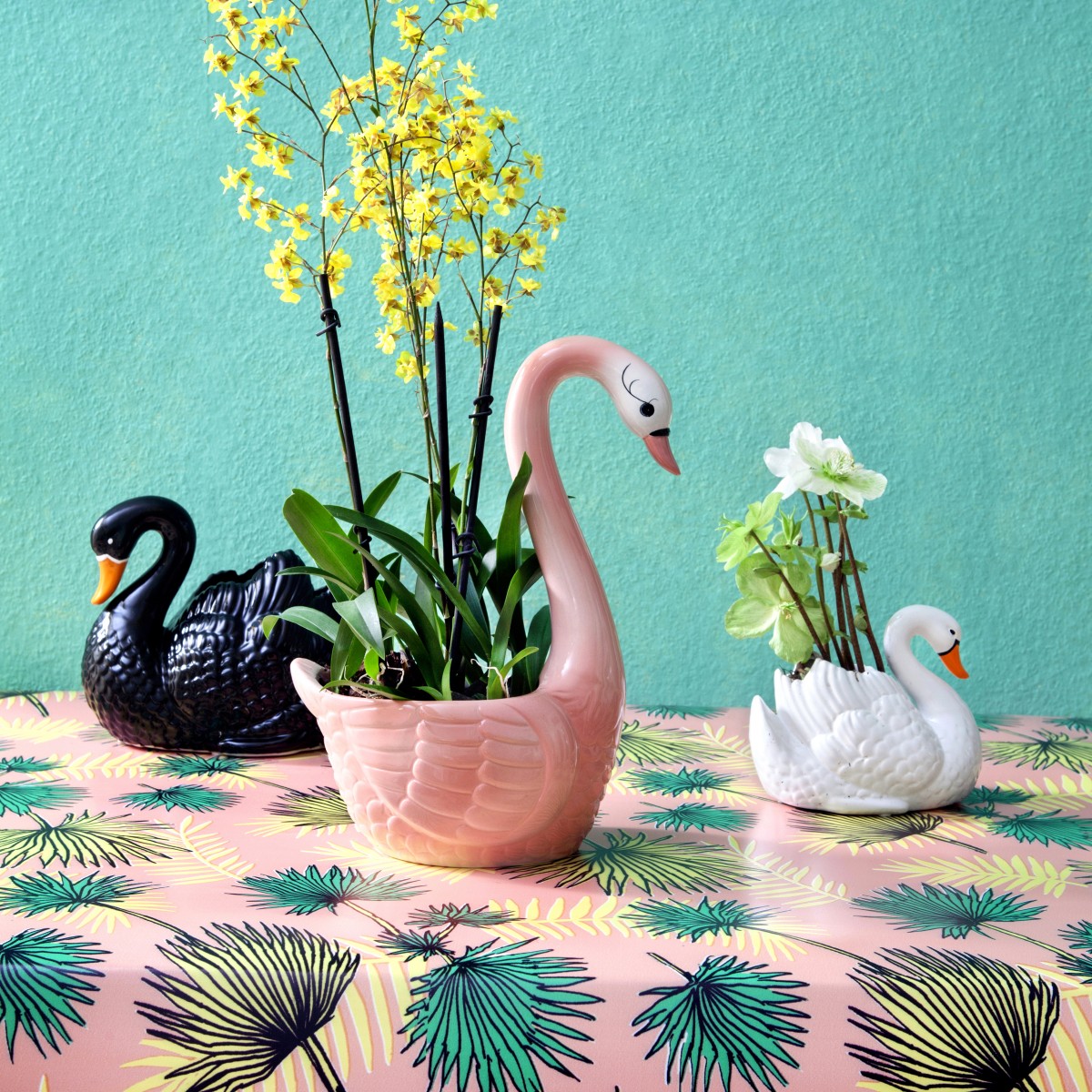
The image looks like it came from the 1970s, what with the pink-and-green patterned tablecloth in oilcloth, and those swan planters/vases. Yes, these are indeed for sale. Then there are the ‘Mexican’ items, including these large tote bags in a tarpaulin fabric featuring the image of our Lady of Guadalupe, which I was very tempted to buy. “It’s the right size for carrying around student assignments!” I exclaimed to my friend. But would the garish colours and the large image of the Virgin Mary shock the students? Would earnest Protestants try to convert me?
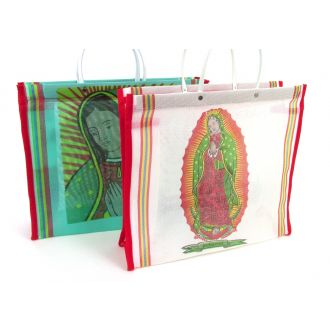
If that style is a bit too over-the-top, there are other, more conventionally pretty, retro styles such as this.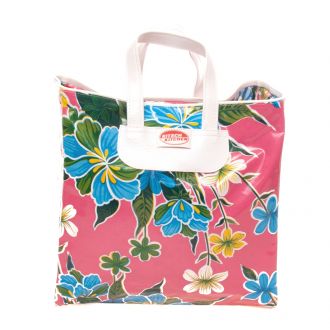
The store is a good place to pick up gifts for kids. There’s a selection of toys, including old-fashioned ones like pull-along animals, plus puzzles and games, some of which are retro-inspired and quite unique. One popular item which I bought was a game of ‘tossing piglets’ – a small pack of small plastic piglets. It’s a simple game: toss the piglets in the air and watch them land, the objective of the game is to try to get them to land on their feet. Rather pointless but the first time you try it, it’s quite funny.
For little girls, there are pretty flower garlands, colourful cheap bracelets, hairclips, and other cute accessories.
The brand is also known for their oilcloth tablecloths (how much more retro can you get?), which come in a wide range of prints, including floral prints much like the pattern on the tote bag above. And for something distinctive, how about something from the Frida Kahlo collection? Items include notepads, a very pretty cushion, or … a bamboo door curtain.

That’s a screenshot from the online shop. So if the mood for a swan planter strikes while you’re far away from Amsterdam, fret not. The store though, carries a wider selection of goods. Needless to say, it’s the kind of shop that women will enjoy while the men will likely say, “honey, while you browse I’ll be round the corner at the bike shop/ having a beer/ at the electronics shop/ doing other manly activity.”
Kitsch Kitchen started life as a market stall over 20 years ago. It gradually expanded into a shop space, and is now a distinctive brand from Amsterdam, even though it’s selling items that aren’t particularly Dutch.
The interesting thing is that products like those in Kitsch Kitchen probably appeal to a western / westernized clientale. The appreciation of kitsch requires a sense of irony. You’re not likely to display a swan planter in your living room simply because you think it’s nice and pretty – you don’t take an item like this at face value, you display it knowingly, aware of its symbolism as a kitsch and retro item. The appeal lies in your knowledge that these things reflected the taste in décor or aesthetics during a certain era, and that this taste is now considered outdated. If you come from a place or culture where these items are still commonplace and are not considered outmoded or ugly, then the irony and humour is lost. (And I don’t think my mum would appreciate the ‘kitsch’ on offer here as I do.) In a similar way, if you’re from one of the cultures that the designers have appropriated for their products, you may not appreciate or recognize how your visual culture or history has been ‘used’ and a price tag put on it. A Lady of Guadalupe bag might elicit very different responses from a predominantly Catholic country with this kind of colourful aesthetic tradition. This, in short, is a process of cultural appropriation. Yet it also reflects the fascination that ‘distant cultures’ hold for a portion of the western world. For some consumers, having these colourful items inspired by other cultures in their homes, gives them pleasure; and in this age of globalization and rampant travelling, it’s not uncommon to see a mish-mash of images and items from different parts of the world in any one home. Exoticism or exoticising places and cultures is now commonplace. Just to take an example: the ‘Balinese house’ concept has travelled well across the world, but it’s definitely better appreciated by non-Balinese.
However, ultimately what Kitsch Kitchen (and other similar brands) are selling, isn’t cultural understanding but a feeling or a mood: the cheerfulness and humour that these colourful items add to your home or to you, the consumer. They state on their website that “we want our products to make you happy!” And many items they carry are of fairly generic colourful designs that aren’t inspired by ‘distant cultures’. Perhaps here, accepting kitsch at face value as kitsch, is what it’s all about.
 travelingpiscean.com