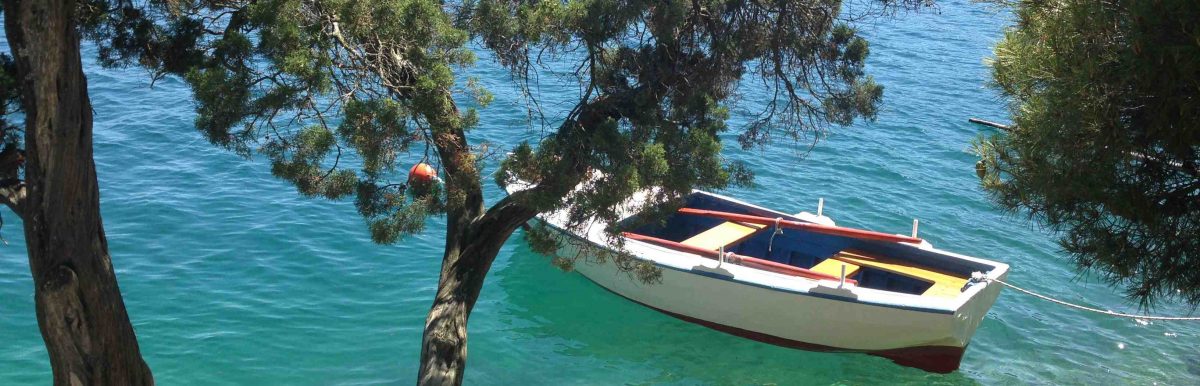
The Cinque Terre is on the bucket list of many a traveller, and justifiably so. Five picture-postcard Italian hilltop villages with pastel-coloured little houses clinging tightly onto steep cliffs rising from an azure sea – it’s the quintessential dream vacation destination.
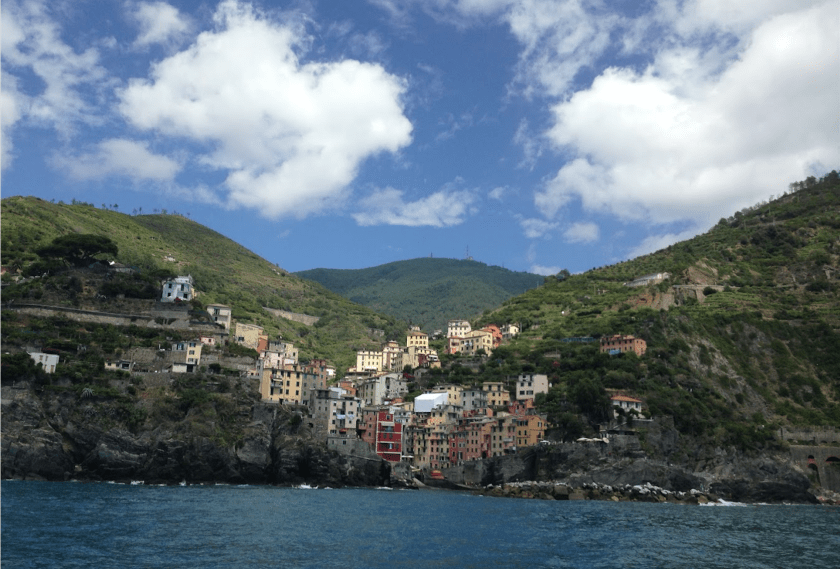
Cinque Terre literally means ‘five lands’. The five lands in question lie along the Ligurian coast in northwest Italy, and they are, from west to east, Monterosso, Vernazza, Corniglia, Manarola and Riomaggiore. The zone around the villages is a UNESCO World Heritage site, and also a designated National Park.
Global fame means the villages can feel unbearably crowded in the middle of the day when tour groups, daytrippers and other travellers choke the small village squares and narrow streets. The Cinque Terre has certainly become a victim of its own picturesqueness and there has been talk of the municipal government imposing a quota on the number of visitors – but so far, that hasn’t happened yet.
Ironically, part of the Cinque Terre’s charm lies in their relative isolation – though you wouldn’t believe it, given the hordes of people who make their way there! In fact, the villages – which date from the Middle Ages – were quite isolated until the 1960s. Because they’re car-free villages and are on steep hills, the best way to get there is by train. The villages are connected by walking trails. Today a tourist attraction, in the past these trails were lifelines – essential connections for neighbours before the railway line arrived.
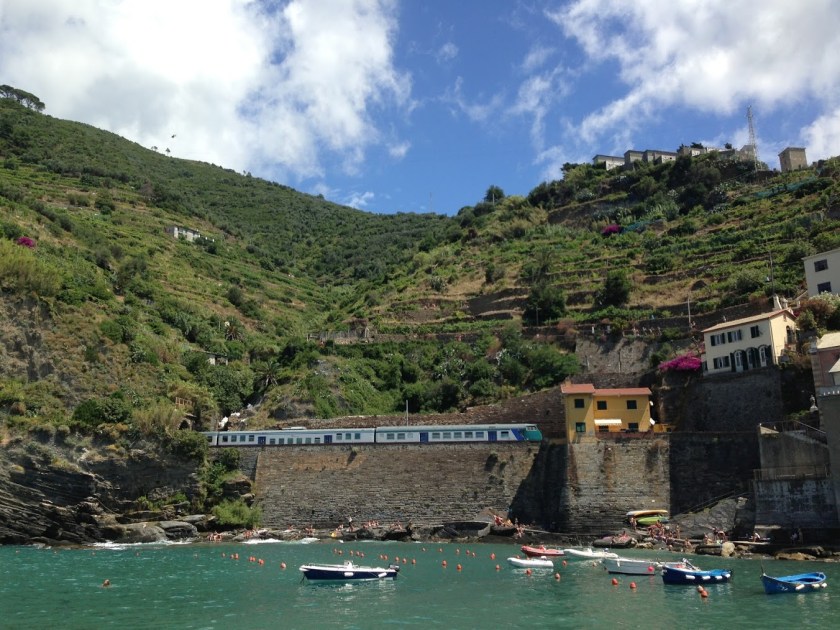
Hanging out in Vernazza’s harbour, looking up at the train tracks and tunnel halfway up the cultivated slopes, I tried to imagine a time before the railway. People would have had to walk between the villages, or go by sea, and when storms hit, each village would be isolated. The history of the land probably accounts for a resiliency and toughness in the bones of the residents whose families have been here for generations.
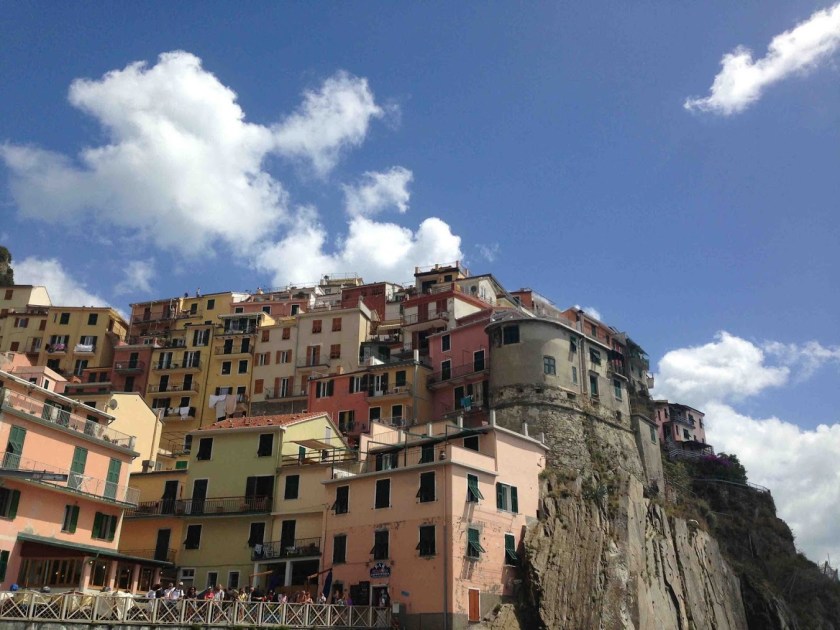
One is guaranteed a good workout here, since the villages are perched on cliffs and there are numerous steps going up or down the narrow alleyways. One of the villages, Corniglia, is perched in such a way that visitors have to contend with lots of steps to/ from the train station, or take a minibus.
Today the Cinque Terre is a short train ride (with regular trains) from the two main cities in the region – La Spezia which is well-connected to other major cities like Florence, and Genoa where the nearest international airport is located. La Spezia train station was a madhouse when I stopped there after leaving the Cinque Terre, with long queues at the ticket machines. If heading to other major cities, it’s easiest to book tickets in advance through the Trenitalia website (the main rail company).
I was fortunate enough to spend five days here a few years ago and found that, provided one is prepared for the tourist crowds, it’s still possible to enjoy ‘la dolce vita’ here. With nothing much to do except wander, take in the beautiful views, soak up the sun, eat and drink, it’s easy to let your life slow down. And it’s still possible to find pockets of tranquility and relatively people-free zones.
When the tourist crowds die down after the hubbub of a hot summer day and as the sun sets, locals spill out on the streets for the cherished Italian tradition of the ‘passeggiata’ – the evening walk when everyone is on the street to meet friends, chat and gossip. The village takes on a different, mellow character. As night fell, we sat contentedly by the harbour listening to the sea and watched the children playing under the watchful eyes of their chatty grandmothers and mothers.

My friend and I travelled to the Cinque Terre from Marseille in France. We discovered that train connections between the south of France and this part of northern Italy weren’t as well-developed as we’d expected but we had a comfortable long-distance bus ride to Genoa from where we hopped on a train to Vernazza, our base for 5 days.
Which village to base oneself in is a big question in the Cinque Terre! We’d spent a considerable amount of time on this, one of the most important factors being the number of steps between train station and the lodging. We’d be schlepping our suitcases in the heat of summer and we weren’t exactly mountain climbers. And travelling during summer means accommodations are in high demand. I used a few websites to find accommodation options including the official Cinque Terre tourism website. The landlord of the apartment we eventually chose, told us the exact number of steps from train station to apartment – this included the steps from the building’s front door to our flat on the first floor. Obviously, this was a frequent query!
Why Vernazza? Well, Corniglia was eliminated because of the aforementioned steps. We decided against Monterosso and Riomaggiore because both seemed somewhat larger that where we hoped to stay. But mostly, we thought we’d found the right apartment at the right price point and location.
Our landlord, an elderly gentleman, met us at the train station and immediately offered to carry our suitcases. We refused because well, we couldn’t do that to a senior, right? But a couple of days later, we spotted him carrying large bags of domestic supplies down Vernazza’s main street, cutting an impressively strapping figure … Yes, there’s toughness in the bones of the people of the five lands.
Because of the apartment’s price point, we knew it wouldn’t be a luxury pad. It was much more like granny’s place – and the furnishings, kitchen appliances (and even the coffee pot) were suitably dated. Not a great surprise to me, as I had seen rentals elsewhere in Italy with furniture of similar vintage. The decor was completed by framed photographs of the Sacred Heart of Jesus and the Virgin Mary.

At the time we went, there was no wifi and internet connection in the apartment, and no TV either. It did, however, come with a washing machine, one of the criteria in our accommodation search.
Some tourists stay in towns near the 5 villages (eg. Levanto, Portovenere, Santa Margherite de Ligure), but accommodation in these towns are not cheap. There are no large and grand hotels in the Cinque Terre because of the geography (small villages), and I was told that many lodgings didn’t have wifi because it was difficult to put the infrastructure in old buildings. We signed up for wifi access at the internet cafe on the main street just steps away from our building. In 2019, there’s now better and more wifi coverage and the province of Liguria has introduced free public wifi (yay) which can be accessed in the main squares. The Cinque Terre Card for tourists also includes free wifi access at the train stations.
Our apartment was in one of the characteristic narrow back alleys (“carugi”) in Vernazza. An easy walk through the main street, lined with souvenir shops, a bakery, and restaurants, took us to Vernazza’s pretty main piazza and harbour where all the action is: the restaurants are usually buzzing, and locals and tourists alike hang out at the harbour where there’s an impressive view of the cultivated terraces above the town. We could spot overheated tourists walking the trails above, and local boys repairing the ancient stone walls of the terraces. These wondrous terraces aren’t there for aesthetic reasons: some date from as far back as the 11th-century when the area was resettled after the Saracens were ousted and they were an inventive way of turning steep slopes into cultivable land.
Agriculture and fishing are still important here. Olives, lemons and grapes are grown. Ligurian olive oil is famous of course, and the Cinque Terre has its own local wine, the sweet white sciacchetrà. Sometimes one can spot a little ‘train’ among the vineyards running on its own tiny tracks – that’s the traditional way of moving crops on the hilly terrain.
A panoramic view can be had of the town’s surroundings and the sea from the Castello dei Doria, a short walk up many stairs from the main square. And even if you’re not religious, the church by the harbour, Santa Margherita d’Antiochia – built in 1318, is atmospheric and takes you back in time. There’s no shortage of atmospheric churches in the five villages.
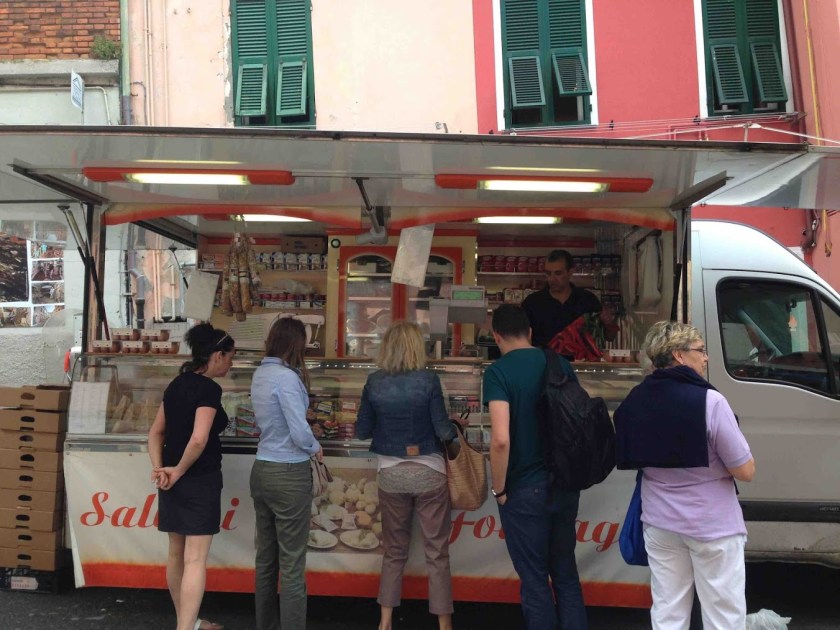
Once a week, there’s a market on Vernazza’s main street, and a chance to behold the rare sight of vehicles – small trucks and vans – in the town, selling meat, cheese, flowers, household goods and utensils and more. We were badly in need of a proper chopping board and queued up behind locals shopping for cleaning and household supplies at the back of a truck. This probably explains why residents keep home appliances and furnishings for years – one can’t simply drive a few minutes to the nearest mall! It’s a simpler life here. It’s also a life that’s closer to nature, however touristy the town has become. The world was reminded of that in 2011 when, after heavy rains, the area was devastated by floods. Vernazza and Monterosso were the worst hit – images of torrents of mud and water cascading down Vernazza’s main street went viral worldwide. Remarkably, the following summer, Vernazza ‘reopened’ for business – testament to the people’s resilience. In the bakery, there is a photograph of the owners, a husband-and-wife team, standing amidst the muddy remains of their shop in 2011. It stands as a reminder that nature is more powerful than we are.
Weather and sea conditions still dictate things here. While there’s a ferry that connects the towns (except for Corniglia, which has no sea access … we never did get to Corniglia in the end), it cannot run if the sea conditions are bad. We were glad that we were staying a few days, as the first time we tried to take the ferry, it wasn’t running even though it was a bright, clear day. Tickets were sold from a folding table at the harbour. The ferry was worth the wait: there’s nothing like seeing the gorgeous villages from the water, particularly on a sunny day. As of 2018, there are other travel options besides the train and ferry: tourists can also travel between the villages on a little tourist shuttle bus.

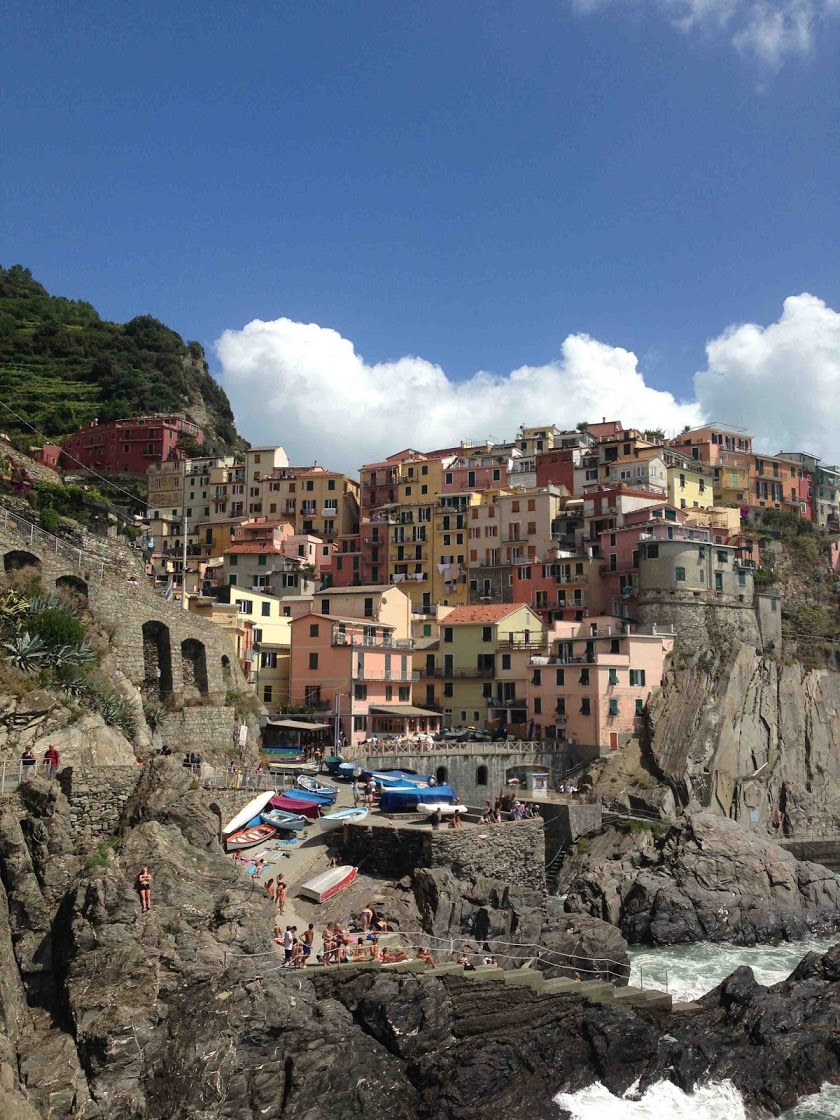
Riomaggiore and Manarola are remarkably pretty, colourful houses perched on cliffs and tumbling down towards rocky harbours. Those rocky harbours … with the inevitable tanned tourist bodies draped everywhere. We saw boats were pulled up halfway up the main street, a sign that the tides could run quite high here. We were mesmerised by the powerful waves smashing against the breakwaters and rocks … and saw daredevil swimmers jumping right into the waves.
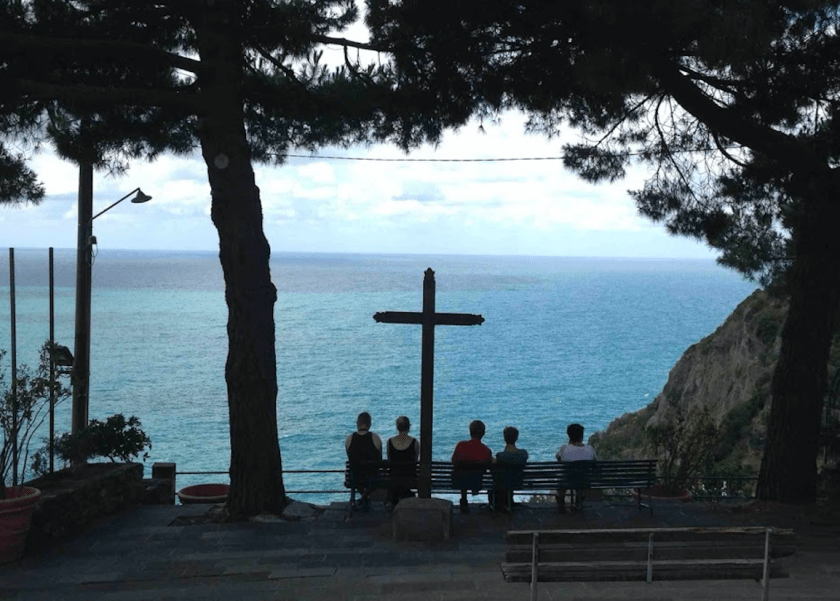
In Riomaggiore we drifted uphill away from the harbour and main squares, in search of more vivid views towards the sea. As we walked up the main street, the aroma of frying fish filled the air, drawing us to explore the ‘chippy’ shops that sell a selection of fried seafood – fish, calamari – in paper cones. Impossible to resist. We kept going higher and ended up at the ancient castle and the Oratory of Saint Rocco – a peaceful location. A cross set by the side of the cliff with a bench provided a spot for contemplation. The higher we went, the fewer the tourists.
In Manarola, our wandering took us out on a trail hugging the coastline; as we walked along the trail the crowds eventually disappeared, and then, dark clouds came rolling in. Even though it was the height of summer, the sky was constantly changing character, making for interesting views of the villages in different lighting conditions.
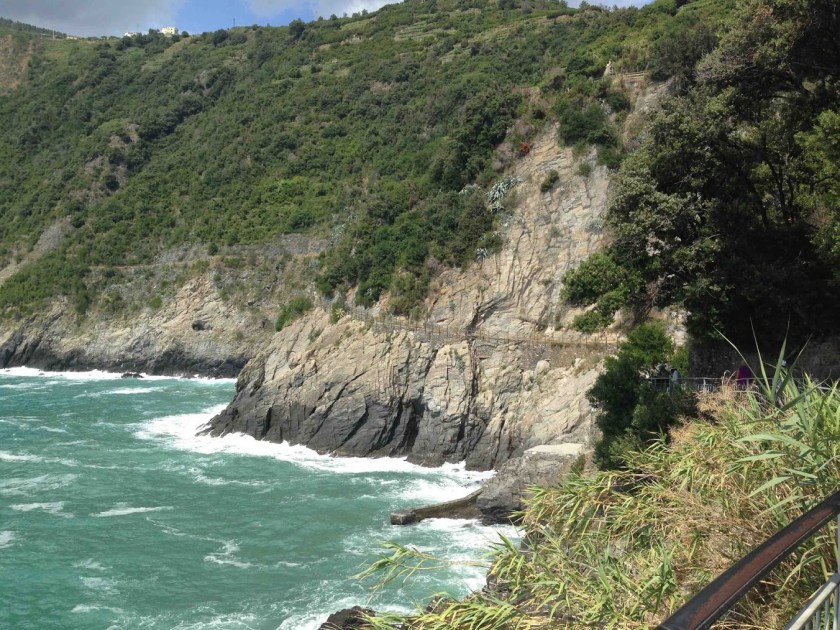
The most famous walking trail in the Cinque Terre is the “Via dell’Amore” which connects Riomaggiore and Manarola. It’s only about a kilometre long and is mostly paved. However, it was closed when we visited. Weather conditions at play again! The trails often need repairing and are occasionally washed out by the rain. Walkers and hikers are advised to check on the conditions of the trails with the tourist offices at the train stations before venturing out. A National Park fee is charged for the main trails, with the fee going towards maintenance of the trails. Secondary trails leading inland up into the hills however, are free. These trails lead to ‘sanctuaries’, small churches in the countryside.
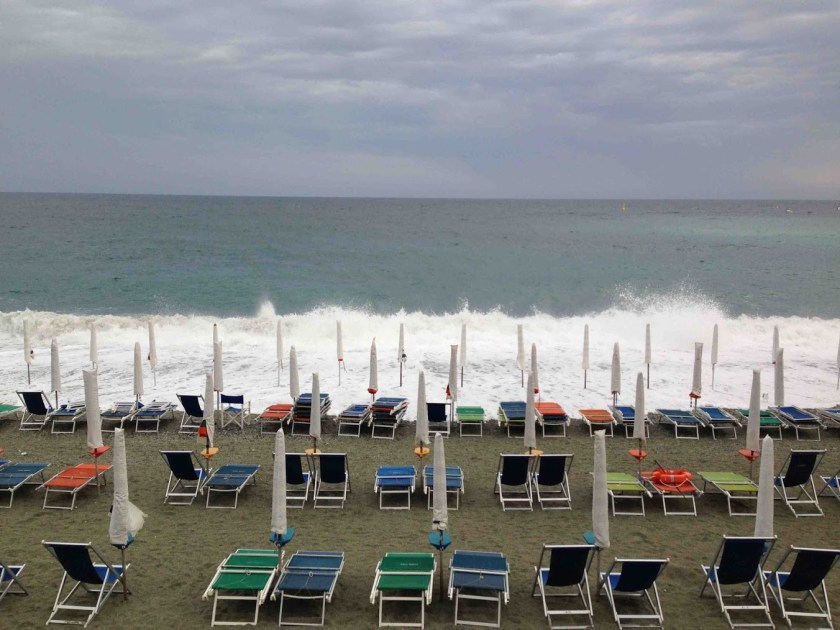
Monterosso is the only village where there is a wide expanse of sandy beach, practically outside the train station. The other villages (except Corniglia – again) have rocky beaches and swimmers and sunseekers also enjoy the sun on the rocks at the harbours. In Vernazza, in addition to the harbour there’s a small cove with a rocky beach. The Monterosso beach is lined with colourful beach umbrellas and deckchairs and flanked by beach clubs, and looks like a typically European beach. Although technically speaking all beaches are free, private concessions operate along stretches of Monterosso’s beach, meaning that beachgoers have to rent deckchairs and umbrellas. However, there are areas where the beach is truly ‘public’.
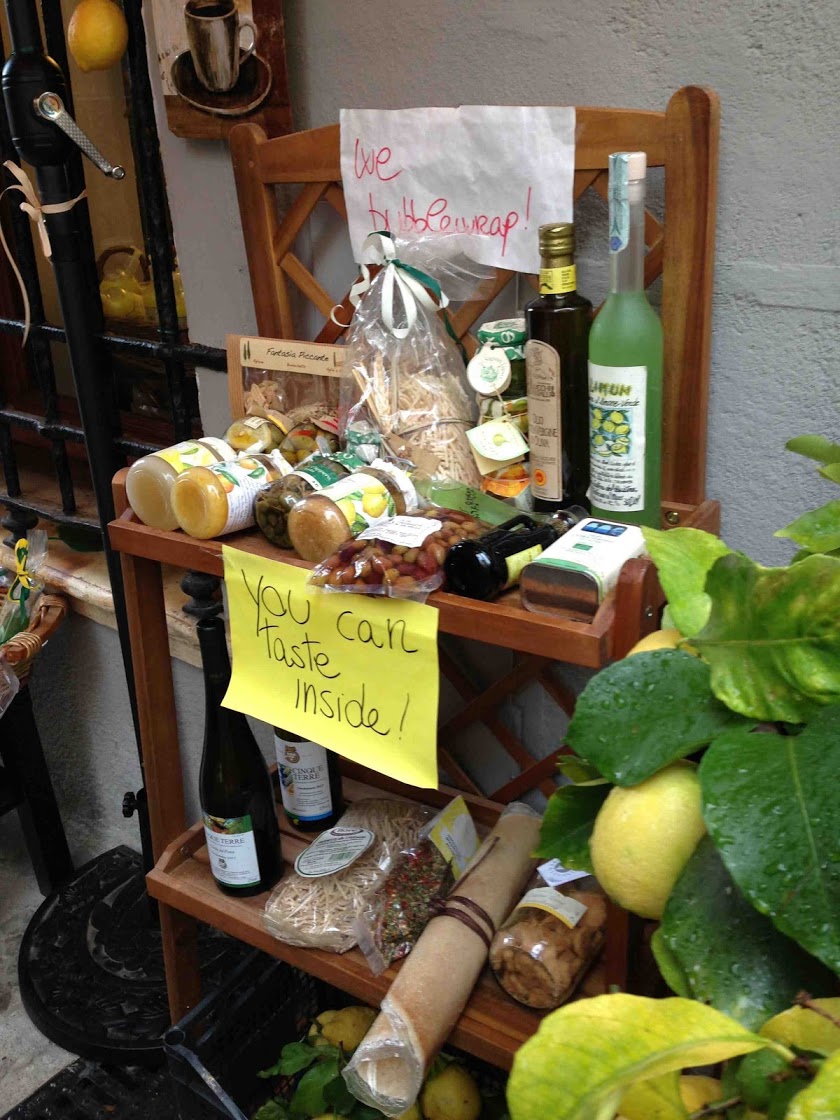
An attractive promenade runs parallel to Monterosso’s beach. We walked past the beach and through a tunnel to the old town, a warren of streets full of shops that should please any tourist in search of mementoes. We spent a couple of hours browsing through a plethora of ceramics, olive oil, pasta and pasta sauces and other typically Italian food products, chatting with the shop owners. For self-catering visitors, this is a great place to pick up local food supplies too: there’s at least one fresh pasta shop, the grocery stores are quite well-stocked and we bought freshly-made pesto for our dinner.
When it comes to food, of course one has to eat fish in the Cinque Terre! Fresh anchovies are a typical speciality of the region, and are nothing like the ones I see at home – those harsh salty little things in a tin. They’re often fried and served with a squeeze of lemon. An interesting fish dish I tried was a fish tortelloni – little pasta parcels stuffed with a white fish and served with a tomato sauce, which initially sounded just wrong to me, but turned out to be delicious!

The local pasta is the small, twisty ‘trofie’, suitable for pairing with the region’s famous pesto, a sauce made of basil, olive oil and pine nuts. Focaccia, now a staple in cafes around the world, also originated here, where they’re brushed with oil, topped simply with olives or sundried tomatoes and baked. For an aperitif, there’s limoncello – a liquor made with lemons. And the local wine is the sweet sciacchetra.
We had quiet evenings once we got back to Vernazza each day, which suited us just fine. Each village does have a few bars / cafes, some of which have a programme of live music, but we were happy to just sit outdoors in the cool evening and observe village life. We were there during the soccer World Cup and as we didn’t have a TV set in our apartment, went around the village looking for a bar or restaurant which might have a TV and screen the matches … no luck, until someone ‘in the know’ pointed us in the direction of a small house off the main square. There was no signage over the door, and it was locked during the day. It was a different story at night: it was a local club of sorts. Rows of chairs were laid out in front of a TV screen, and the small bar was manned by a middle-aged man. The chairs gradually filled with locals and tourists, eagerly awaiting the game of the night. Sadly, the European tourists outnumbered, outcheered and outshouted the locals, and I wondered if we were invading a cherished local social space, even though the local people treated us with courtesy.

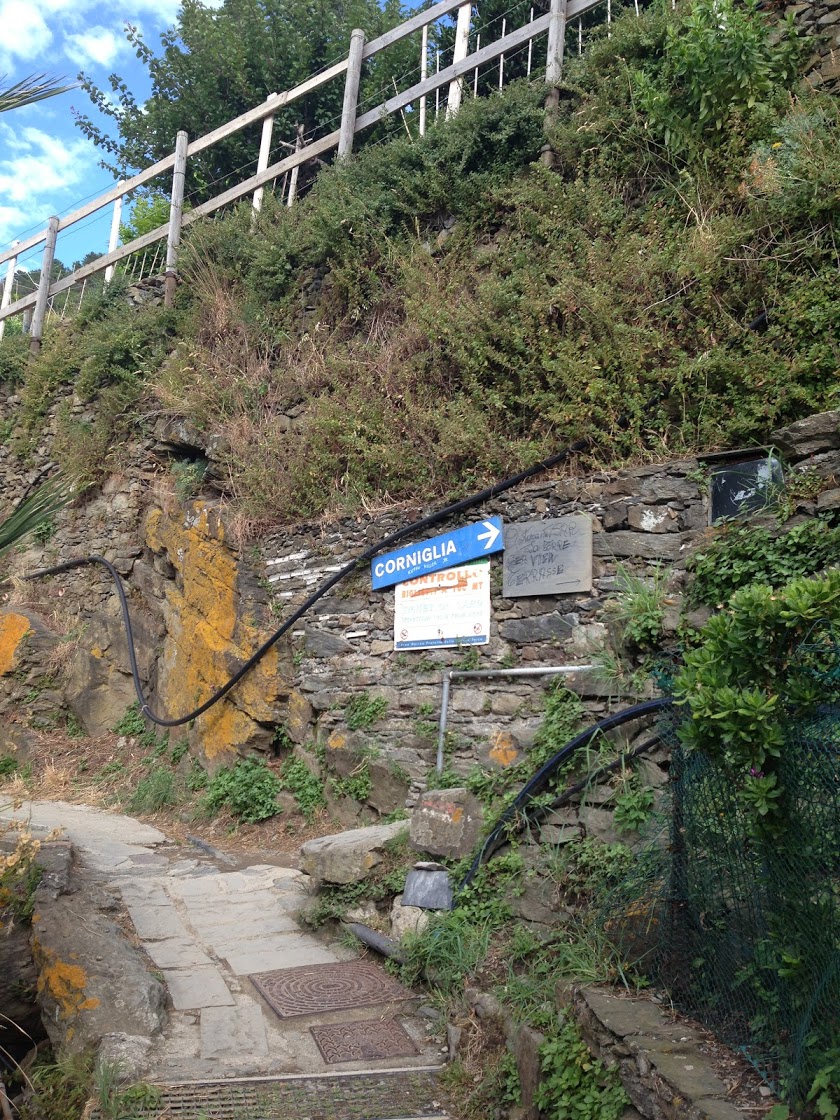
One lazy afternoon in Vernazza, we decided to just wander, and found ourselves partway up the trail towards Corniglia (and we still didn’t make it all the way there). To my surprise, we were practically the only ones on the trail. Perhaps it was too hot and everyone was having a siesta after lunch. What a pleasure it was to slowly walk, turn back, and watch the village fall away below, a little smaller each time you looked, and the sea sparkling in the sun.
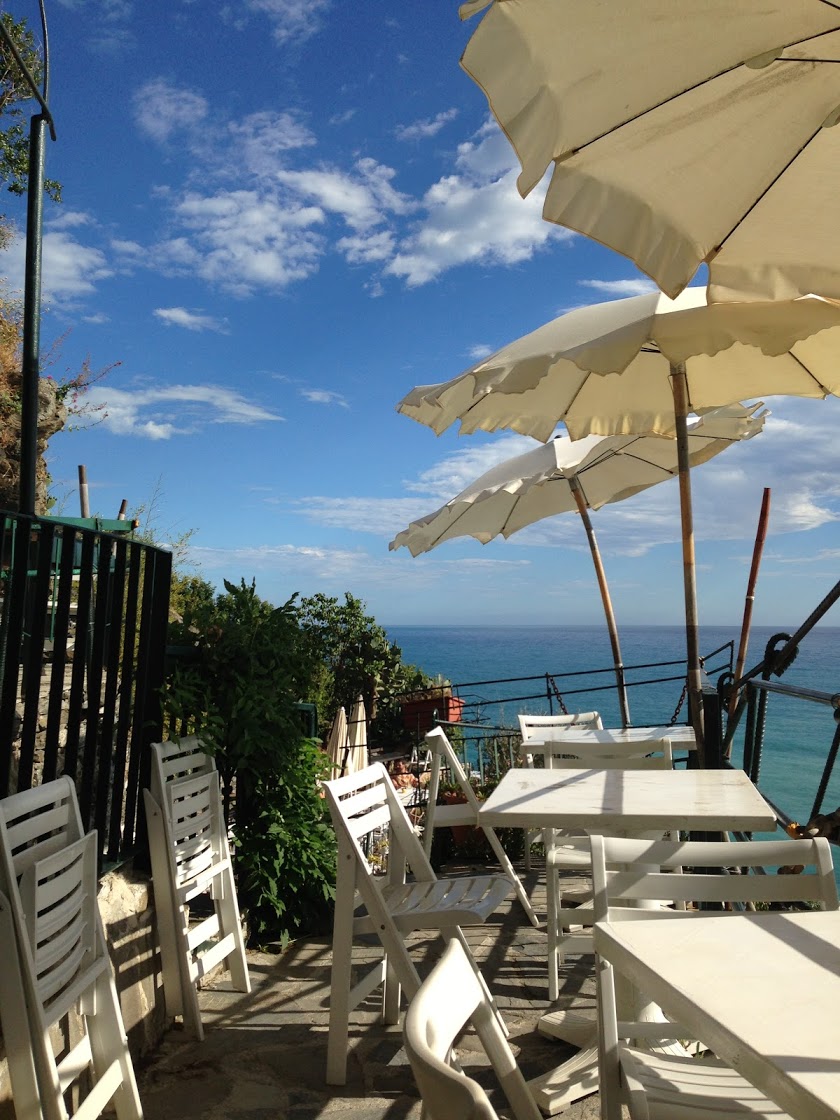
I felt like I had all the time in the world. As the afternoon temperatures soared, we stopped at a cafe with a gorgeous view out to the sea, where there were only 2 other customers. Sipping our fresh orange juices in the afternoon sun, the only words that came to mind were “la dolce vita”. Bliss.

It was actually possible to escape the crowds in the Cinque Terre, after all. One just had to walk, wander, look around, and take your time to savour each sight, sound, and taste. And perhaps one day, I will get to Corniglia.

 travelingpiscean.com